
Download the form
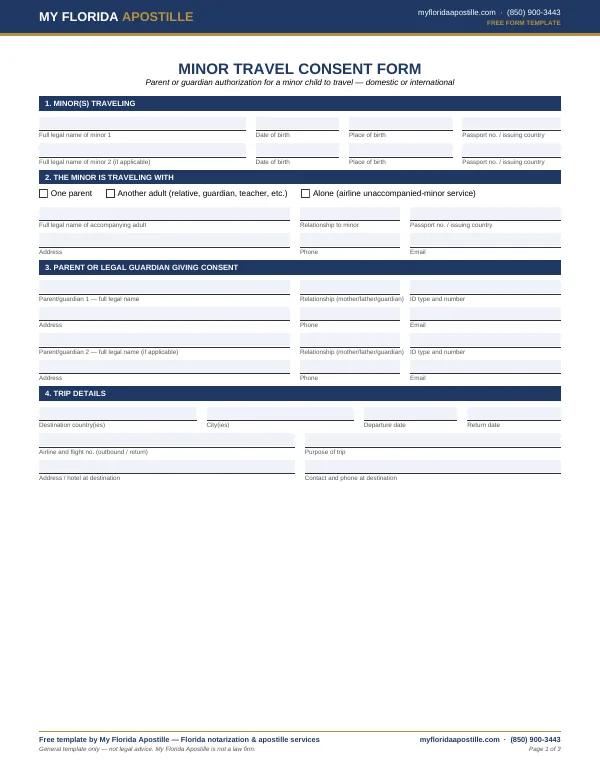
Covers one or two children, any travel arrangement, and one or two consenting parents. The last page walks you through signing, notarizing and apostilling it.
When a child needs this form
Airlines, border agents and foreign immigration officers can ask for proof that both parents agree to a minor's trip. The situations that come up most:
- One parent travels with the child. The parent staying home signs. This is the classic case for Mexico, Canada, the Caribbean and South America, where officers routinely ask for a notarized letter when a child crosses with only one parent.
- The child travels with another adult — a grandparent, aunt, coach, teacher or family friend. Both parents sign.
- The child flies alone under an airline's unaccompanied-minor service. Both parents sign, and the airline's own paperwork comes on top of this form.
Domestic flights rarely require it, but a notarized consent still helps if a child travels with a non-parent and anything goes wrong (a medical visit, a missed connection). For international trips it is close to mandatory, and several countries will not let a minor leave without it.
How to fill in each section
| Section | What to enter |
|---|---|
| 1. Minor(s) traveling | Full legal name exactly as on the passport, date and place of birth, passport number and issuing country. Two children fit on one form; for three or more, use a second copy. |
| 2. Traveling with | Tick one box. If the child travels with a parent or another adult, give that adult's details. If the child flies alone, leave the adult fields blank and write the airline's unaccompanied-minor service in Section 4. |
| 3. Parent or guardian giving consent | The person signing. Enter the non-traveling parent when one parent travels; enter both parents when the child travels with someone else or alone. A legal guardian signs here with a copy of the guardianship order attached. |
| 4. Trip details | Destination country and cities, departure and return dates, flight numbers, where the child is staying and a phone number there. Officers compare these against the tickets, so be exact. |
| 5. Consent and authorization | The statement itself, including permission for emergency medical treatment. Nothing to fill in — read it, then sign only in front of the notary. |
| Notarial certificate | Leave blank. The notary completes it. |
Leave the signature and date lines empty until you are with the notary, so the signature date matches the certificate. Officers do spot pre-dated signatures.
Signing and notarizing it in Florida
The form carries a Florida acknowledgment certificate, the certificate most commonly used for a consent letter: the notary confirms that you are who you say you are and that you signed willingly. You need:
- a current government-issued photo ID (driver's license, state ID or passport);
- your physical presence or an online notarization session, which Florida treats the same way — the certificate has a checkbox for each;
- both parents present if both are signing, or two separate notarized copies if they sign in different places.
The notary fills in the county, the date, your name, the ID line and applies the seal. Check that nothing in the certificate is left blank; an incomplete certificate is the most common reason a notarized document is refused, in Florida and abroad.
If one parent is outside Florida or outside the United States, online notarization solves it: they sign by video with a Florida-commissioned notary from anywhere, and the notarized PDF can then be apostilled like a paper original.
When the consent also needs an apostille
A notarized letter is enough for most airlines and for entry into many countries. An apostille becomes necessary when a foreign authority has to rely on the document officially — most often when:
- the destination country's immigration rules say the consent must be apostilled or legalized (Mexico, Brazil, Colombia, Argentina, Peru and the Dominican Republic all ask for this in some situations);
- the child will be enrolled in school, treated in a hospital or registered with authorities abroad;
- a consulate in the U.S. has asked for an apostilled consent before issuing the child's visa or exit permit.
The Florida Department of State apostilles the notary's signature, not the letter itself, so the certificate on this form has to be complete and in English. We file in person in Tallahassee and return the apostilled document in 5–7 business days; see the travel consent apostille service.
Country notes
- Mexico — a Mexican minor, or a foreign minor resident in Mexico, leaving Mexico alone or with someone other than a parent needs the INM's official Formato de Salida de Menores (SAM), not a private letter; leaving with one parent, no form is required. A U.S. child entering Mexico with one parent is usually fine with this notarized form; some airlines ask for it at check-in. Apostille for Mexico.
- Brazil, Argentina, Colombia, Peru, Venezuela — strict exit controls for minors who are citizens or residents. These countries often require a consent signed before their consulate or a locally recognized notary, or an apostilled foreign consent plus a certified translation. Check with the consulate before you travel. See Brazil, Colombia, Peru.
- Dominican Republic, Honduras, Nicaragua — commonly ask for an apostilled and translated consent when a minor resident leaves with one parent. The Spanish version of this form avoids a translation in most cases.
- Canada and the European Union — no formal requirement, but border officers are instructed to ask when a child travels with one parent. A notarized letter answers the question; an apostille is rarely requested.
What to carry on the day
- This form, original, notarized — not a photocopy
- The child's passport, and a copy of the signing parent's ID
- A copy of the child's birth certificate showing both parents' names
- Custody order or death certificate if only one parent has authority
- The apostille attached, if the destination requires one
Minor Travel Consent Form — Free. No email required. Fillable on screen or by hand.
Download free PDFCommon questions
General template, not legal advice. My Florida Apostille is not a law firm and cannot advise which form to use.