
Download the form
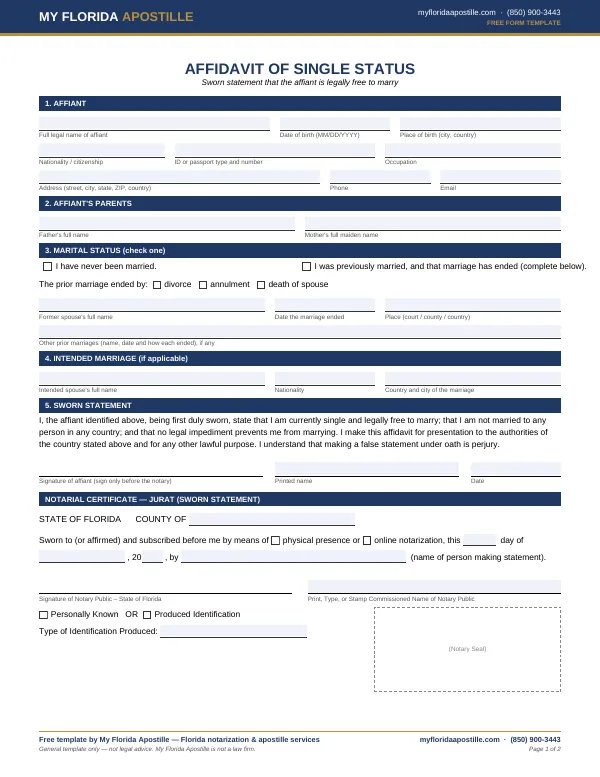
Handles never-married, divorced and widowed applicants, records the intended marriage, and keeps the sworn statement on the same page as the notary's jurat.
What this affidavit is for
The United States does not issue a certificate of no impediment, and Florida's own single-status statement only searches Florida marriage records. So when a registry in Mexico, Colombia, Italy, Spain, the Philippines or almost anywhere else asks for a constancia de soltería, certificado de capacidad matrimonial, nulla osta or "certificate of freedom to marry", what a Florida resident actually provides is this: a sworn affidavit, notarized with a jurat and apostilled.
This form puts the facts registries ask about — your identity, your parents, your marital history, the intended marriage — into one page, with the oath and the Florida jurat directly underneath. For the background on how registries treat it, read how to write a single status affidavit.
How to fill in each section
| Section | What to enter |
|---|---|
| 1. Affiant | Your full legal name as on your passport, date and place of birth, nationality, ID or passport number, occupation and address. Registries in Latin America and Southern Europe expect the occupation and the parents' names, which U.S. forms usually omit. |
| 2. Parents | Father's full name and mother's full maiden name. |
| 3. Marital status | Tick never married, or previously married and give the former spouse's name, the date the marriage ended and the court or place. If more than one prior marriage, list the others in the last row. |
| 4. Intended marriage | Optional but useful: the intended spouse's name and nationality, and where the wedding will take place. Some registries require it to be named. |
| 5. Sworn statement | Read it. Sign and date only in front of the notary — a jurat records that you swore to it in the notary's presence. |
Swearing to it: the jurat
This affidavit needs a jurat, not an acknowledgment: you are swearing that the statement is true, and that oath is what the registry relies on. The form's certificate reads "Sworn to (or affirmed) and subscribed before me…", with the Florida checkboxes for physical presence or online notarization and for the type of ID produced.
Bring a government-issued photo ID. The notary administers the oath, watches you sign, completes the certificate and seals it. Any blank line in the certificate, a missing seal or a notary whose commission has expired will get the document refused — in Tallahassee or at the registry.
Outside Florida or outside the U.S.? A Florida online notary can take your oath by video from anywhere, and the notarized PDF is apostilled exactly like a paper original.
Apostille and timing
Registries abroad accept the affidavit only with an apostille from the Florida Department of State (or, for a non-Hague country, a Florida authentication followed by consular legalization). We file in person and return it in 5–7 business days.
Timing matters more with this document than with any other: most registries only accept proof of single status issued within the last three to six months, and some count from the apostille date. Sign and apostille it once your wedding date is set, not months in advance. The same window usually applies to the apostilled birth certificate and divorce decree the registry will ask for alongside it.
Pricing and process: single status affidavit apostille.
Country notes
- Mexico — registries ask for a constancia de soltería or declaración jurada de soltería; the apostilled affidavit plus an apostilled birth certificate is the standard package. Use the Spanish version. Mexico.
- Colombia, Peru, Dominican Republic, Honduras, Nicaragua — same approach. The Dominican Republic often requires a translation of the apostille itself; Colombia accepts the Spanish affidavit as is. Colombia · Dominican Republic.
- Italy — the comune wants a nulla osta or a sworn declaration; U.S. citizens usually obtain the consular statement, and some comuni also accept this apostilled affidavit with a sworn translation. Ask the comune first. Italy.
- Spain — civil registries ask for a certificado de capacidad matrimonial or a sworn affidavit of single status plus the apostilled birth certificate; the affidavit must be recent. Spain.
- Philippines — some local civil registrars accept an apostilled affidavit of single status for the U.S. partner; others require the affidavit in lieu of a certificate of legal capacity sworn at the U.S. Embassy in Manila. Ask the LCR first. Philippines.
- Brazil — the cartório requires an apostille and a sworn translation; a bilingual form does not replace the translation. Brazil.
Single Status Affidavit — Free. No email required. Fillable on screen or by hand.
Download free PDFCommon questions
General template, not legal advice. My Florida Apostille is not a law firm and cannot advise which form to use.