
Download the form
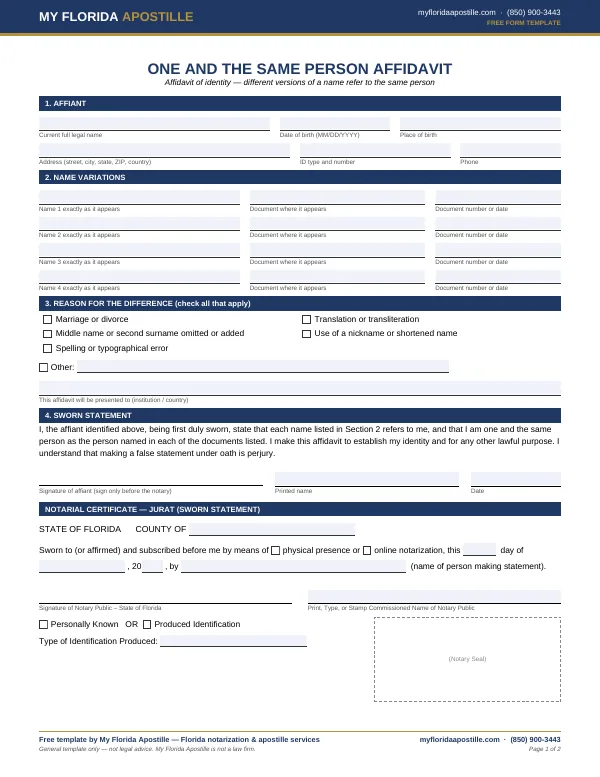
Room for four name variations with the document each appears on, checkboxes for the reason (marriage, missing middle name, spelling, transliteration, nickname) and the sworn statement with jurat.
When names don't match
Foreign registries read names literally. A missing second surname, a hyphen, a maiden name, an accent dropped by a U.S. clerk, "Bill" on a diploma and "William" on a passport — any of these can stall a citizenship application, a marriage file, an inheritance or a university enrollment. The usual fix is a sworn affidavit of identity, often called a "one and the same person" affidavit: you list each version of the name, the document it appears on, and swear that they all refer to you.
Typical triggers:
- Italian, Spanish or Portuguese citizenship by descent, where every generation's records must line up;
- marriage abroad, when the birth certificate and passport differ;
- a diploma or transcript issued under a maiden or shortened name;
- Latin American records with two surnames against U.S. records with one;
- transliterated names (Cyrillic, Arabic, Hebrew, Chinese) spelled differently across documents.
The affidavit does not change your name. It explains it. A legal name change still requires a court order, which can itself be apostilled.
How to fill in each section
| Section | What to enter |
|---|---|
| 1. Affiant | Your current full legal name as on your passport, date and place of birth, address and ID number. |
| 2. Name variations | One row per version, copied exactly as it appears — including accents, hyphens, middle initials or missing names — with the document it appears on and that document's number or date. List the passport version first. |
| 3. Reason for the difference | Tick all that apply. For anything unusual, use the "Other" line (e.g. "Second surname omitted by U.S. Social Security Administration"). Name the institution and country the affidavit will be presented to. |
| 4. Sworn statement | Read it; sign and date only before the notary. |
If the institution asks, attach plain copies of the documents listed in Section 2. Do not staple them to the affidavit before the apostille — the Department of State apostilles the notarized page only, and attachments can be refused.
Notarizing it
Florida jurat: you swear before the notary that the statement is true, then sign in the notary's presence. Bring the photo ID that shows your current legal name. The notary identifies you by that ID; the affidavit's job is to connect it to the other versions.
In person at a Florida office by appointment, or by video with a Florida online notary from any state or country.
Apostille
Since the whole point is to satisfy a foreign authority, the affidavit almost always needs an apostille from the Florida Department of State (or an authentication for non-Hague countries). We file in person and return it in 5–7 business days. Order it together with the records it explains so everything arrives at once: affidavit apostille.
Country notes
- Italy — comuni and consulates handling jure sanguinis applications often want discrepancies explained by an affidavit or resolved by a court order; ask which the office accepts before you file. Italy.
- Spain and Portugal — citizenship and residency files with a missing second surname are the classic case; the Spanish version of this form is accepted after apostille. Spain · Portugal.
- Mexico, Colombia, Peru, Venezuela, Dominican Republic — for marriage, inheritance and dual-nationality files where U.S. records dropped a surname or an accent. Mexico · Colombia.
- Israel, India, Philippines — transliteration and maiden-name differences on diplomas and civil records; an apostilled affidavit with a translation where required. Israel · India · Philippines.
One and the Same Person Affidavit — Free. No email required. Fillable on screen or by hand.
Download free PDFCommon questions
General template, not legal advice. My Florida Apostille is not a law firm and cannot advise which form to use.