
Download the form
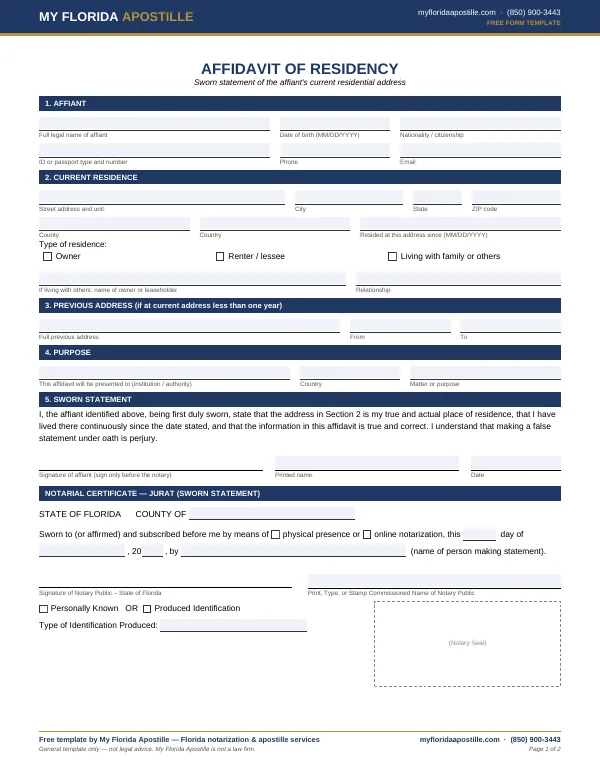
Current address with move-in date, owner/renter/living-with-family status, a previous address if recent, and the purpose and country where it will be presented.
When an affidavit of residency is asked for
An affidavit of residency (also called an affidavit of residence or of domicile) is your sworn statement of where you live. Institutions ask for it when ordinary proof of address is not enough or does not exist:
- Consulates and foreign registries — for dual nationality files, consular registration, passport renewals for a child, pension or benefit claims, or proof that you live outside the home country (Mexico, Colombia, Peru, Venezuela and Honduras all ask for it in some procedures).
- Banks abroad — opening or maintaining an account as a non-resident.
- Schools and scholarships — proof of a family's residence when enrolling a child or applying for aid.
- Family and immigration paperwork — proof of cohabitation or of where a relative lives.
- Florida situations — when you live with family and have no bill in your name, a landlord or relative can sign to confirm you live at their address.
Most institutions want the affidavit and a supporting document: a lease, utility bill, bank statement or driver's license at the same address. The affidavit gives the sworn statement; the bill gives the paper trail.
How to fill in each section
| Section | What to enter |
|---|---|
| 1. Affiant | Your full legal name, date of birth, nationality, ID or passport number and contact details. |
| 2. Current residence | Street address with unit number, city, state, ZIP, county and country, and the date you moved in. Tick owner, renter or living with family. If you live with others, name the owner or leaseholder and your relationship — that person can sign a separate copy as the host if the institution asks for it. |
| 3. Previous address | Only if you have been at the current address less than a year. Consulates often ask for residence history. |
| 4. Purpose | Name the institution and country, and the procedure (e.g. "consular registration", "bank account", "school enrollment"). A purpose-specific affidavit is accepted more readily than a generic one. |
| 5. Sworn statement | Read it; sign and date only in front of the notary. |
Notarizing it
The affidavit uses a Florida jurat: you swear or affirm before the notary that the statement is true, then sign. Bring a current government-issued photo ID; if the ID shows a different address than the one you are swearing to, bring a supporting document for the new address as well — the notary does not verify your address, but the institution will compare the two.
The oath can be taken in person at one of our Florida offices by appointment, or by video with a Florida online notary from anywhere.
When it needs an apostille
Any affidavit going to a foreign authority needs an apostille so that authority can verify the notary. Domestic uses (a Florida school, a U.S. bank) do not. We file in Tallahassee and return the apostilled affidavit in 5–7 business days; see affidavit apostille. For a non-Hague country, Florida issues an authentication instead.
If the authority asked for a government-issued certificate of residence (a constancia de residencia from a municipality, for example), be aware that a sworn affidavit may not replace it. Ask what they accept from U.S. residents before you pay for the apostille; a notarized and apostilled affidavit is the usual answer, but not the only one.
Country notes
- Mexico — consulates and the SAT, IMSS and civil registries ask for comprobante de domicilio; when a Florida resident cannot produce a Mexican one, an apostilled Spanish affidavit of residence plus a utility bill is the usual substitute. Mexico.
- Colombia and Venezuela — used for consular registration, pension claims and residencia procedures; include the purpose and the consulate's name. Colombia · Venezuela.
- Peru, Honduras, Nicaragua, Dominican Republic — accepted for consular and banking matters when apostilled; the Spanish version avoids a translation. Peru · Dominican Republic.
- Italy and Spain — citizenship-by-descent and residency files sometimes ask for proof of the applicant's residence abroad; the apostilled affidavit is accepted with a translation. Italy · Spain.
Affidavit of Residency — Free. No email required. Fillable on screen or by hand.
Download free PDFCommon questions
General template, not legal advice. My Florida Apostille is not a law firm and cannot advise which form to use.