
Download the form
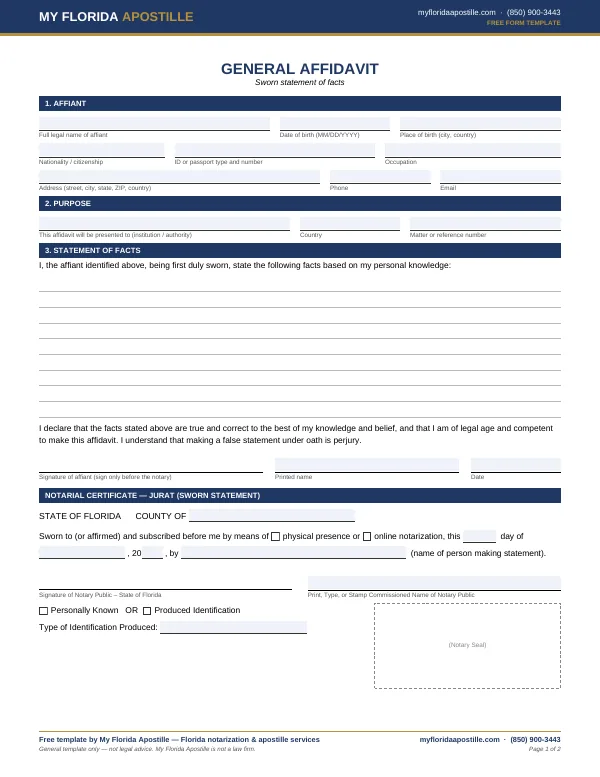
Affiant details, the institution and matter it is for, a full page for numbered facts, the closing oath and the jurat on the same page as your signature.
What a general affidavit is
An affidavit is a written statement of facts that you swear or affirm is true before a notary. The notary records your oath in a jurat. Because you are personally liable for perjury, institutions treat an affidavit as evidence in a way they will not treat a plain letter.
This general form is for everything the specialized forms don't cover. Common uses from our customers:
- a relative's statement for a citizenship or marriage file (that two records refer to the same ancestor, that a couple lives together, that a parent consents);
- a statement about a lost, destroyed or never-issued document;
- a statement of support, income or employment when the usual letter is not available;
- facts about a birth, death or marriage that was never registered;
- a company officer's statement of authority or incumbency;
- any declaration a consulate, bank, university or foreign court has asked for "under oath".
If what you need is a single status, residency, identity or travel consent statement, use the dedicated form instead — it already contains the facts those institutions look for.
How to fill in each section
| Section | What to enter |
|---|---|
| 1. Affiant | Your full legal name, date and place of birth, nationality, ID number, occupation and address. |
| 2. Purpose | The institution or authority, the country, and the matter or reference number (case number, application number, student ID). Affidavits written for a named purpose are accepted far more readily than generic ones. |
| 3. Statement of facts | Numbered paragraphs, one fact each, in the first person and the past or present tense: "1. I am the mother of Ana López Pérez, born in Tampa, Florida on May 3, 2015." State only what you know personally, with dates, places and full names. Avoid opinions, arguments and legal conclusions — a registry wants facts it can check. If you run out of room, write "continued on attached page" and attach a signed second copy. |
| Closing and signature | Read the closing oath. Sign and date only before the notary. |
Swearing to it
Bring a current government-issued photo ID. The notary administers the oath ("Do you swear or affirm that the statements in this affidavit are true?"), watches you sign, and completes the Florida jurat with the county, date, your name, the ID line and the seal. The checkboxes for physical presence and online notarization are on the certificate, so it works equally for an appointment at a Florida office and for a video session with a Florida online notary.
If the institution gave you its own affidavit wording, use theirs and have it notarized the same way; the Florida jurat on this form shows exactly what the certificate should look like.
Apostille
For use abroad, the affidavit needs an apostille from the Florida Department of State (or an authentication for a non-Hague country). The apostille certifies the notary, which is why the jurat must be complete and in English even when the statement is written in Spanish. We file in person in Tallahassee and return the document in 5–7 business days: affidavit apostille.
Country notes
- Mexico, Colombia, Peru, Venezuela, Honduras, Nicaragua, Dominican Republic — a declaración jurada written in Spanish on this form, notarized and apostilled, is normally accepted without translation; Dominican offices may want the apostille translated. Mexico · Colombia.
- Italy, Spain, Portugal — citizenship files often use third-party affidavits to reconcile ancestral records; a sworn translation is needed after the apostille (Spain generally accepts the Spanish version; Portugal usually asks for a translation). Italy · Spain.
- Brazil, Germany — an apostilled affidavit must be translated by a sworn translator; a bilingual form does not replace that step. Brazil · Germany.
- India, Philippines, South Africa, Israel — affidavits in English are accepted with the apostille; some Indian and Philippine offices also want them on their own prescribed format. India · Philippines.
General Affidavit — Free. No email required. Fillable on screen or by hand.
Download free PDFCommon questions
General template, not legal advice. My Florida Apostille is not a law firm and cannot advise which form to use.